



Cyril CALIOTDirecteur(trice) de recherche
 LMAP UMR 5142 UPPA/CNRS
1 allée du parc Montaury, 64600 Anglet
- CNRS
 Equipe Méthodes Numériques et Fluides Complexes
 Courriel
Parcours
Parcours
2015 Habilitation à diriger des recherches - Université de Perpignan Via-Domitia
2006 Doctorat en Physique - Institut National Polytechnique de Toulouse (IMT Mines Albi, RAPSODEE)
2002 DEA "Thermique et Systèmes Énergétiques" - Université de Champs-sur-Marne
Postes
2019 - Chargé de Recherche CNRS - Université de Pau et des Pays de l'Adour (France) Membre du LMAP UMR5142
2008 - 2019 Chargé de Recherche CNRS - Four Solaire d'Odeillo (France) PROMES-CNRS UPR 8521
2007 - 2008 Post-Doctorat - PROMES-CNRS UPR 8521
2006 - 2007 Post-Doctorat - ICA IMT Mines Albi
Projets
Due to rapid urbanisation, 70% of the world population is projected to live in cities by 2050. In the context of global climate change (Collins et al., 2013), the combination of increasing regional air temperature, more frequent heat waves and a potentially stronger Urban Heat Island (UHI; Arnfield, 2003) due to larger cities lead to high risk for humans and infrastructure in future cities. Implementation of weather and climate services can make cities more resilient against climate change impacts. Long-term projections are critical to inform climate change mitigation and adaptation policies concerning infrastructure projects, city planning, climate-proofing and smart building design in climate vulnerable areas (Goal 9, 2030 Agenda, United Nations, UN). In addition, specific meteorological studies can help strategic planning for climate-resilient cities (Goals 11 and 13, 2030 Agenda, UN).
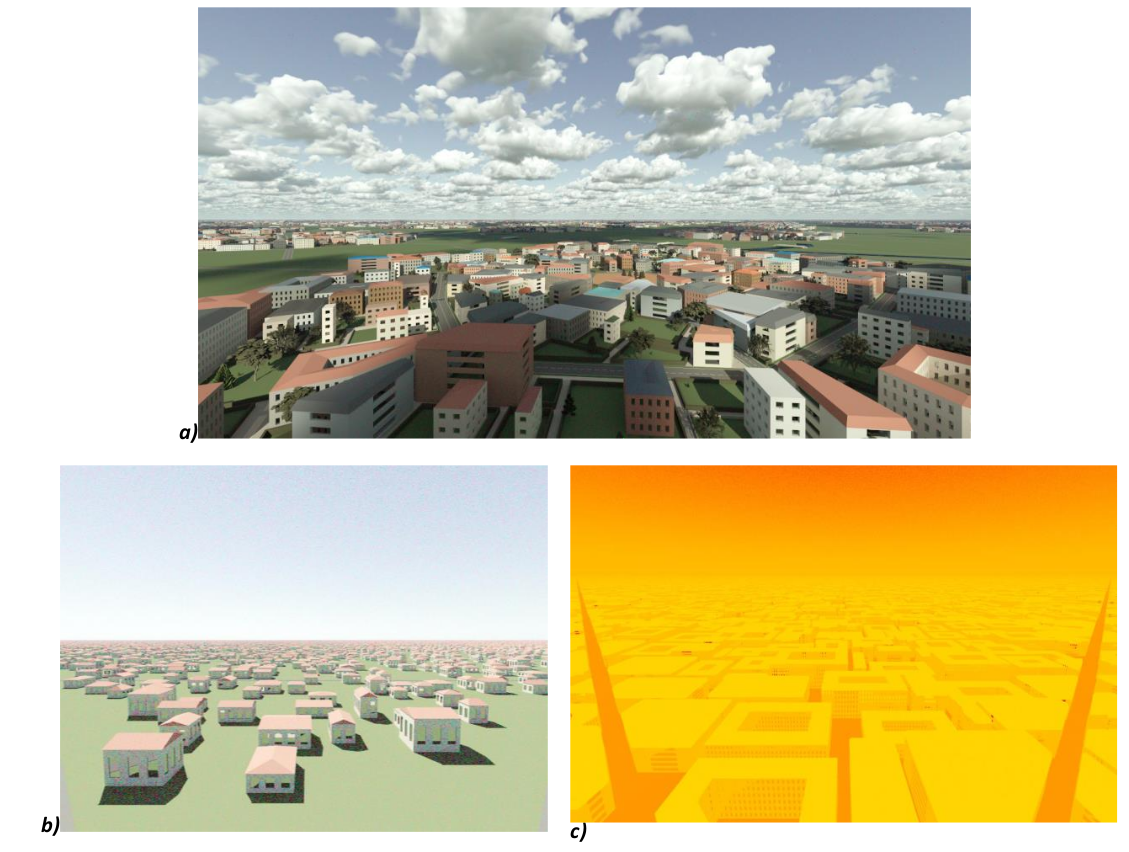
The climate modelling community is thus challenged to provide society with climate outputs to inform adaptation choices, often not being able to clearly identify the expectation. On the other hand, scientists who develop detailed models to design energetically efficient infrastructures like cities, are struggling to scale up from the technology level (e.g. insulating materials) to the full infrastructure and then to the level of a relevant geographical entity on climatic time scales. The present project is based on two recent breakthroughs in Monte Carlo methods that pave the way for new approaches to tackle these challenges: 1) the demonstration that path-tracing algorithms can be used for the computation of coupled radiative exchange and heat conduction (Fournier, 2016, Caliot 2018) and 2) the possibility of building fast models/emulators, based on precomputed paths, to relate a target to input parameters (radiation sources, initial and boundary temperature for thermal computations) (L. Penazzi, 2019 and 2020). This method will be referred to later on in the document as Symbolic MC. The breakthroughs make possible both 1) reference simulations resolving the full dynamical flow coupled with thermal and radiative exchanges in an obstacle-resolving city model, and 2) computation of user-oriented integrated metrics such as the energy consumption of an entire city over a climatic period. In both cases, every geometric detail and physical process involved can be accounted for. These computations, which were inconceivable so far, benefit from the same ray-tracing techniques that revolutionised the animated movie industry a few years ago. A key aspect of these computations (Monte-Carlo integration methods for probe calculations) is their insensitivity to the problem complexity and number of dimensions since no discretisation is required. Thus, Monte-Carlo (MC) methods can handle complex geometry with large scale ratio, strong directional and spectral dependence of radiative properties, and transient boundary conditions. The main goal of the MC2 project is to develop and implement innovative MC methods to accurately and efficiently capture the effect of the city’s complexity in combined turbulent flow and heat transfer simulations for weather and climate services. The new approach developed aims at the scaling up of meteorological and climate simulations to account for the full 3D description of an entire city with various material properties. The first objective of the MC2 project is to provide high-resolution multi-scale and multi-physics simulations of city-atmosphere interaction that account for the complex geometry of cities including the variety of material characteristics. The city-atmosphere exchanges of momentum and heat are influenced by the 3D building geometry which alters the near-surface wind field (Moonen et al., 2012), leads to shading and multiple reflection of solar radiation, trapping of terrestrial infrared radiation, and favours heat storage in the construction materials. Cities therefore experience higher (nocturnal) air temperature (the UHI) which can lead to risks for human health due to enhanced heat stress (Gabriel and Endlicher, 2011), and an increase of building energy consumption for air conditioning (Santamouris et al., 2001; Salamanca et al., 2013). Two types of deterministic models are widely used to simulate the city-atmosphere interaction. The Urban Canopy Models (UCMs) strongly simplify the urban geometry and are suited for the representation of cities in numerical weather prediction and regional climate models. The Obstacle-Resolving Models (ORMs) account for the complex urban geometry, but are limited by their inability to extend the size and complexity of the domain (restricted to a district) as well as to account for strong radiative directional and spectral dependencies. First, the MC2 project will develop a new Monte-Carlo based method to solve the combined radiative exchange and heat conduction coupled to the turbulent flow in an obstacle-resolving micro-scale meteorological simulation (WP1) at high spatial resolution (~1 m) including detailed urban geometry and physical properties for an entire city (Fig. 1). The differences between the new MC based model and a deterministic model will be analysed for idealised cities representing typical urban districts and a real city (Toulouse), including an evaluation against field observations.
Figure 1. a) Photo-realistic rendering by Monte-Carlo of a city under a simulated atmosphere including clouds computed at 8 m spatial resolution with a large-eddy simulation (10 9 cells) of the Meso-NH model; b) Monte-Carlo based rendering of an idealised urban district produced using the CityGenerator and representative of detached low-rise buildings (Local Climate Zone ‘Sparsely Built’, ‘Pavillons Discontinus’ in the French urban morphology classification of Tornay et al., 2017); c) Infrared rendering of ‘Continuous Building with closed courtyard’ (‘Immeubles continus sur îlot fermé’).
Pure outdoor radiative transfer for such districts is currently investigated in the MODRADURB project. The MC2 project will extend the investigations to the much more scientifically and technically challenging coupled convection-conduction-radiation.
The second objective of the MC2 project is to develop fast city models that integrate the city’s geometry complexity directly in the atmospheric column of global or regional climate models, thus accounting for the local coupling with the atmosphere in a simplified way. This fast model will fully benefit from the two breakthroughs mentioned above. The fast city models (WP2) will be validated against the fully coupled obstacle-resolving simulations and can be used for efficient global climate
model downscaling, impact studies, and urban climate services. It will be used to compute metrics such as the energy consumption for air conditioning required to maintain the temperature inside the buildings of a city at a given setpoint. Thanks to the above mentioned breakthroughs, this computation will be done on climatic time scales, and at the scale of a geographical entity (region, country) benefiting from the capability of sampling the time and location together with the complexity of the city, in a single probe Monte Carlo algorithm. To remove the technical barriers to a widespread use of these new models and algorithms, the developed scientific libraries will be made available to the community (WP3) via Free and Open-Source Software (FOSS).
Publications
Articles dans des revues scientifiques internationales
Cyprien Heisel, Cyril Caliot, Thierry Chartier, Sylvain Chupin, Patrick David, et al.. Digital design and 3D printing of innovative SiC architectures for high temperature volumetric solar receivers. Solar Energy Materials and Solar Cells, Elsevier, 2021, 232, pp.111336. ⟨10.1016/j.solmat.2021.111336⟩. ⟨hal-03335187⟩
E. Ribeiro, G. Plantard, J.-F. Cornet, F. Gros, C. Caliot, V. Goetz. Experimental and theoretical coupled approaches for the analysis of radiative transfer in photoreactors containing particulate media: case study of TiO2 powders for photocatalytic reactions, Chemical Engineering Science, 2021, 116733, 10.1016/j.ces.2021.116733.
Chuan Jiang, Jun Wang, Omar Behar, Cyril Caliot, Yaoming Zhang, et al.. A modified numerical integration method to calculate the view factor between finite and infinite cylinders in arbitrary array. Annals of Nuclear Energy, Elsevier Masson, 2020, 142, pp.107358. ⟨10.1016/j.anucene.2020.107358⟩. ⟨hal-03006702⟩
Ludovic Charpentier, Cyril Caliot, Jean-Louis Sans, Angélique Bousquet. The impact of oxidation on the optical properties of Si–SiC materials. Ceramics International, Elsevier, 2020, 46, pp.28536. ⟨10.1016/j.ceramint.2020.08.011⟩. ⟨hal-02916030⟩
F. Henault, Cyril Caliot, M. Coquand, P.-H. Defieux, E. Guillot. Sun backward gazing method for measuring optomechanical errors of solar concentrators: experimental results. Applied optics, Optical Society of America, 2020, 59 (31), pp.9861. ⟨10.1364/AO.399595⟩. ⟨hal-03006761⟩
P. Lapeyre, Stéphane Blanco, Cyril Caliot, J. Dauchet, Mouna El-Hafi, et al.. Monte-Carlo and sensitivity transport models for domain deformation. Journal of Quantitative Spectroscopy and Radiative Transfer, Elsevier, 2020, 251, pp.1-13/107022. ⟨10.1016/j.jqsrt.2020.107022⟩. ⟨hal-02639249⟩
Alberto Sánchez-González, Benjamin Grange, Cyril Caliot. Computation of canting errors in heliostats by flux map fitting: experimental assessment. Optics Express, Optical Society of America - OSA Publishing, 2020, 28 (26), pp.39868. ⟨10.1364/OE.412116⟩. ⟨hal-03080613⟩
Antonio Avila-Marin, Cyril Caliot, Monica Alvarez de Lara, Jesus Fernandez-Reche, Maria Jose Montes, et al.. Homogeneous equivalent model coupled with P1-approximation for dense wire meshes volumetric air receivers. Renewable Energy, Elsevier, 2019, 135, pp.908-919. ⟨10.1016/j.renene.2018.12.061⟩. ⟨hal-02328200⟩
Jeremi Dauchet, Jean-Jacques Bézian, Stéphane Blanco, Cyril Caliot, Julien Charon, et al.. Addressing nonlinearities in Monte Carlo. Scientific Reports, Nature Publishing Group, 2018, 8 (1), art.13302-11 p. ⟨10.1038/s41598-018-31574-4⟩. ⟨hal-01871366⟩
François Hénault, Mathieu Coquand, Pierre-Henri Defieux, Cyril Caliot. Sun backward gazing method with multiple cameras for characterizing solar concentrators. Solar Energy, Elsevier, 2018, 166, pp.103 - 114. ⟨10.1016/j.solener.2018.03.042⟩. ⟨hal-01906222⟩
Antonio Avila-Marin, Cyril Caliot, Gilles Flamant, Monica Alvarez de Lara, Jesús Fernandez-Reche. Numerical determination of the heat transfer coefficient for volumetric air receivers with wire meshes. Solar Energy, Elsevier, 2018, 162, pp.317 - 329. ⟨10.1016/j.solener.2018.01.034⟩. ⟨hal-01897979⟩
P. Déjardin, Y. Cornaton, P. Ghesquière, Cyril Caliot, R. Brouzet. Calculation of the orientational linear and nonlinear correlation factors of polar liquids from the rotational Dean-Kawasaki equation. Journal of Chemical Physics, American Institute of Physics, 2018, 148 (4), ⟨10.1063/1.5010295⟩. ⟨hal-01704362⟩
Ludovic Charpentier, Cyril Caliot. The impact of the oxidation on the optical properties of TaC. Solar Energy Materials and Solar Cells, Elsevier, 2017, 171, pp.16 - 23. ⟨10.1016/j.solmat.2017.06.019⟩. ⟨hal-01887711⟩
Florent Larrouturou, Cyril Caliot, Gilles Flamant. Influence of receiver surface spectral selectivity on the solar-to-electric efficiency of a solar tower power plant. Solar Energy Materials, Elsevier, 2016, 130, pp.Pages 60-73. ⟨10.1016/j.solener.2016.02.008⟩. ⟨hal-01310933⟩
B. Rousseau, S. Guevelou, A. Mekeze-Monthe, J. Vicente, L. del Campo, et al.. Tuning the spectral emittance of alpha-SiC open-cell foams up to 1300 K with their macro porosity. AIP Advances, American Institute of Physics- AIP Publishing LLC, 2016, 6 (6), ⟨10.1063/1.4955142⟩. ⟨hal-01459220⟩
Simon Guevelou, Benoit Rousseau, Gilberto Domingues, Jérôme Vicente, Cyril Caliot. Representative elementary volumes required to characterize the normal spectral emittance of silicon carbide foams used as volumetric solar absorbers. International Journal of Heat and Mass Transfer, Elsevier, 2016, 93, pp.118-129. ⟨10.1016/j.ijheatmasstransfer.2015.09.069⟩. ⟨hal-01459084⟩
Cyril Caliot, Hadrien Benoit, Emmanuel Guillot, Jean-Louis Sans, Alain Ferriere, et al.. Validation of a Monte Carlo Integral Formulation Applied to Solar Facility Simulations and Use of Sensitivities. Journal of Solar Energy Engineering, American Society of Mechanical Engineers, 2015, 137 (2), 8 p. ⟨10.1115/1.4029692⟩. ⟨hal-01174959⟩
F. Ordonez, Cyril Caliot, F. Bataille, Guy Lauriat. Improvement of Radiative Performances of High Temperature Solar Particle Receivers Using Coated Particles and Mixtures. Journal of Solar Energy Engineering, American Society of Mechanical Engineers, 2015, 137 (2), pp.021009. ⟨10.1115/1.4028562⟩. ⟨hal-01083751⟩
Benoit Rousseau, Gilberto Domingues, Jérôme Vicente, Cyril Caliot, Gilles Flamant, et al.. EVOLUTION OF THE HOMOGENIZED VOLUMETRIC RADIATIVE PROPERTIES OF A FAMILY OF α-SiC FOAMS WITH GROWING NOMINAL PORE DIAMETER. Journal of Porous Media, Begell House, 2015, 18 (10), pp.1031 - 1045. ⟨10.1615/JPorMedia.2015012283⟩. ⟨hal-01790844⟩
Florent Larrouturou, Cyril Caliot, Gilles Flamant. Effect of directional dependency of wall reflectivity and incident concentrated solar flux on the efficiency of a cavity solar receiver. Solar Energy Materials, Elsevier, 2014, 109, pp.153-164. ⟨10.1016/j.solener.2014.08.028⟩. ⟨hal-01178189⟩
J. Delatorre, Germain Baud, Jean-Jacques Bézian, Stéphane Blanco, Cyril Caliot, et al.. Monte Carlo advances and concentrated solar applications. Solar Energy, Elsevier, 2014, 103, p.653-681. ⟨10.1016/j.solener.2013.02.035⟩. ⟨hal-01625034⟩
Cyril Caliot, Gilles Flamant. Pressurized Carbon Dioxide as Heat Transfer Fluid: Influence of Radiation on Turbulent Flow Characteristics in Pipe. AIMS Energy, AIMS Press, 2014, 3 (2), pp.172-182. ⟨10.3934/energy.2014.2.172⟩. ⟨hal-01178150⟩
F. Ordonez, Cyril Caliot, F. Bataille, Guy Lauriat. Optimization of the optical particle properties for a high temperature solar particle receiver,. Solar Energy, Elsevier, 2014, pp.42. ⟨10.1016/j.solener.2013.11.014⟩. ⟨hal-01083743⟩
Maxime Roger, Cyril Caliot, Nicolas Crouseilles, Pedro Jorge Martins Coelho. A hybrid transport-diffusion model for radiative transfer in absorbing and scattering media. Journal of Computational Physics, Elsevier, 2014, 275, pp.346 - 362. ⟨10.1016/j.jcp.2014.06.063⟩. ⟨hal-01090680⟩
M. Galtier, Stéphane Blanco, Cyril Caliot, C. Coustet, J. Dauchet, et al.. Integral formulation of null-collision Monte Carlo algorithms. Journal of Quantitative Spectroscopy and Radiative Transfer, Elsevier, 2013, 125, pp.57-68. ⟨10.1016/j.jqsrt.2013.04.001⟩. ⟨hal-01688110⟩
H.I. Villafán-Vidales, Stéphane Abanades, Cyril Caliot, H. Romero-Paredes. Heat transfer simulation in a thermochemical solar reactor based on a volumetric porous receiver. Applied Thermal Engineering, Elsevier, 2011, 31 (16), pp.3377. ⟨10.1016/j.applthermaleng.2011.06.022⟩. ⟨hal-00789864⟩
Cyril Caliot, S. Abanades, Anouar Soufiani, Gilles Flamant. Effects of non-gray thermal radiation on the heating of a methane laminar flow at high temperature. Fuel, Elsevier, 2009, 88 (4), pp.617-624. ⟨10.1016/j.fuel.2008.10.025⟩. ⟨hal-00497854⟩
Cyril Caliot, Vincent Eymet, Mouna El-Hafi, Yannick Le Maoult, G. Flamant. Parametric study of radiative heat transfer in participating gas-solid flows. International Journal of Thermal Sciences, Elsevier, 2008, 47 (11), pp.1413-1421. ⟨10.1016/j.ijthermalsci.2007.10.016⟩. ⟨hal-01712152⟩
Cyril Caliot, G. Flamant, Mouna El-Hafi, Yannick Le Maoult. Assessment of the single-mixture gas assumption for the correlated K-distribution fictitious gas method in H2O-CO2-CO mixture at high temperature. Journal of Heat Transfer, American Society of Mechanical Engineers, 2008, 130 (10), ⟨10.1115/1.2946475⟩. ⟨hal-01712153⟩
Cyril Caliot, Yannick Le Maoult, Mouna El-Hafi, G. Flamant. Remote sensing of high temperature H2O-CO2-CO mixture with a correlated k-distribution fictitious gas method and the single-mixture gas assumption. Journal of Quantitative Spectroscopy and Radiative Transfer, Elsevier, 2006, 102 (2), pp.304-315. ⟨10.1016/j.jqsrt.2006.02.017⟩. ⟨hal-01712156⟩
Conferences
Léa Penazzi, Stéphane Blanco, Cyril Caliot, Christophe Coustet, Mouna El-Hafi, et al.. Transfer function estimation with SMC method for combined heat transfer: insensitivity to detail refinement of complex geometries. CHT-21 ICHMT - International Symposium on Advances in Computational Heat Transfer, Aug 2021, Rio de Janeiro (online), Brazil. pp.383-386. ⟨hal-03374353⟩
Morgan Sans, Stéphane Blanco, Cyril Caliot, Mouna El-Hafi, Olivier Farges, et al.. Méthode de Monte-Carlo Symbolique pour la caractérisation des propriétés thermiques : application à la méthode flash. SFT 2021 - 29 ème congrès Franças de Thermique, Jun 2021, Belfort (online), France. pp.293-300, ⟨10.25855/SFT2021-076⟩. ⟨hal-03260534⟩
Paule Lapeyre, Stéphane Blanco, Cyril Caliot, Mouna El-Hafi, Richard Fournier. Monte Carlo et sensibilité géométrique, modèle de transport de sensibilité. SFT 2020 - 28 ème congrès Franças de Thermique, Jun 2020, Belfort, France. pp.577-584, ⟨10.25855/SFT2020-061⟩. ⟨hal-02928687⟩
Chloé Dezani, Cyril Caliot, Vincent Goetz, Gael Plantard. Etablissement d’un modèle représentatif de la dégradation de la cafeine dans un photoréacteur ouvert sous conditions d’irradiations dynamiques. SFGP, Oct 2019, Nantes, France. ⟨hal-02332814⟩
Chloé Dezani, Vincent Goetz, Cyril Caliot, Gael Plantard. Modeling the capcity of a continuous flow photocatalyitic reactor with dynamic solar irradiation conditions. 6th European Conference on Environment Apllications of Advanced Oxidation Processes, Jun 2019, Portoroz, Slovenia. ⟨hal-02332806⟩
Paule Lapeyre, Stéphane Blanco, Cyril Caliot, Jérémi Dauchet, Mouna El-Hafi, et al.. Monte-Carlo and Domain-Deformation Sensitivities. RAD-19 - 9th International Symposium on Radiative Transfer, Jun 2019, Athens, Greece. 8 p. ⟨hal-02265080⟩
Loris Ibarrart, Stéphane Blanco, Cyril Caliot, Mouna El-Hafi, Richard Fournier, et al.. Couplage conducto-convecto-radiatif par échantillonnage de chemins : un parallèle avec les chemins de multi-diffusions en transfert radiatif. SFT 2019 - 27ème Congrès Français de Thermique, Jun 2019, Nantes, France. p. 239-246. ⟨hal-02441250⟩
Vincent Eymet, Forest Vincent, Benjamin Piaud, Christophe Coustet, Richard Fournier, et al.. Synthèse d'images infrarouges sans calcul préalable du champ de température. SFT 2019 - 27ème Congrès Français de Thermique, Jun 2019, Nantes, France. pp.153-160. ⟨hal-02419604⟩
Léa Penazzi, Stéphane Blanco, Cyril Caliot, C. Coustet, Mouna El-Hafi, et al.. Toward the use of Symbolic Monte Carlo for Conduction-Radiation Coupling in Complex Geometries. RAD-19 - 9th International Symposium on Radiative Transfer, Jun 2019, Athens, Greece. 8 p., ⟨10.1615/RAD-19.380⟩. ⟨hal-02265075⟩
Ludovic Charpentier, Cyril Caliot, Patrick David, Anthony Baux, Cyprien Heisel, et al.. Influence of the porosity of SiC on its optical properties and oxidation kinetics. SOLARPACES 2018: International Conference on Concentrating Solar Power and Chemical Energy Systems, Oct 2018, Casablanca, France. pp.030013, ⟨10.1063/1.5117525⟩. ⟨hal-02313786⟩
Bertrand Garnier, J. Camus, Ahmed Ould El Moctar, Cyril Caliot, Emmanuel Guillot, et al.. Thin film sensor for heat flux distribution measurement of concentrated solar irradiance. 4th International Conference on Sensors and Electronic Instrumental Advances (SEIA'2018), Sep 2018, Amsterdam, Netherlands. ⟨hal-02386418⟩
Loris Ibarrart, Cyril Caliot, Mouna El-Hafi, Richard Fournier, Stéphane Blanco, et al.. Combined conductive-convective-radiative heat transfer in complex geometry using the Monte Carlo method: application to solar receivers. IHTC 16 - 16th International Heat Transfer Conference, THE HEAT AND MASS TRANSFER SOCIETY OF CHINA; TSINGHUA UNIVERSITY, Aug 2018, Beijing, China. 8 p. ⟨hal-01882644⟩
Bertrand Garnier, Julien Camus, Cyril Caliot, Emilien Guillot, Abdelhak Djouadi. Fluxmètre pour la mesure de la distribution spatiale de flux thermique élevée. Colloque Défi Instrumentation aux Limites du CNRS, May 2018, Paris, France. ⟨hal-02899548⟩
Cyril Caliot, Stéphane Blanco, Christophe Coustet, Mouna El-Hafi, Vincent Eymet, et al.. Combined conductive-radiative heat transfer analysis in complex geometry using the Monte Carlo method. CTRPM-VI - 6th Computational Thermal Radiation in Participating Media VI, EUROTHERM, Apr 2018, Cascais, Portugal. 8 p. ⟨hal-01853128⟩
Cyril Caliot, Stéphane Blanco, Christophe Coustet, Mouna El-Hafi, Vincent Eymet, et al.. Combined conductive-radiative heat transfer analysis in complex geometry using the Monte Carlo method. ECOS 2017 - 30th International Conference on Efficiency, Cost, Optimization, Simulation and Environmental Impact of Energy Systems, Jul 2017, San Diego, United States. 6 p. ⟨hal-01876179⟩
Cyril Caliot, Stéphane Blanco, Christophe Coustet, Vincent Eymet, Vincent Forest, et al.. Résolution des transferts conducto-radiatifs par la méthode de Monte-Carlo en milieux poreux. SFT 2017 - Congrès annuel de la Société Française de Thermique , May 2017, Marseille, France. 8 p. ⟨hal-01630830⟩
Sébastien Mey-Cloutier, Cyril Caliot, Gilles Flamant. Validation expérimentale d'un modèle d'absorbeur volumique solaire à haute température. 13èmes Journéess d'études des Milieux Poreux 2016, Oct 2016, Anglet, France. ⟨hal-01394522⟩
Julien Charon, Stéphane Blanco, Cyril Caliot, Jean-François Cornet, Jeremi Dauchet, et al.. Résolution de l'approximation de Schiff par la méthode de Monte Carlo pour l'évaluation des propriétés radiatives des micro-organismes photosynthétiques. SFT 2016 - Congrès annuel de la Société Française de Thermique, May 2016, Toulouse, France. 8 p. ⟨hal-01706792⟩
F. Ordonez, Cyril Caliot, F. Bataille, Guy Lauriat. Modelling and optimization of a cold emitting, spectrally absorbing and anisotropically scattering 1D solar particle receiver. Eurotherm Seminar No 98, Concentrating Solar Energy Systems, Jul 2013, Vienne, Austria. ⟨hal-01091058⟩
F. Ordonez, Cyril Caliot, F. Bataille, Guy Lauriat. Modelling and optimization of a cold emitting, spectrally absorbing and anisotropically scattering 1D solar particle receiver. Eurotherm Seminar No 98, Concentrating Solar Energy Systems,, Jul 2013, Vienne, Austria. pp.5. ⟨hal-00839792⟩
F. Ordonez, Cyril Caliot, F. Bataille, Guy Lauriat. Optimization of a spectrally absorbing and anisotropically scattering 1D particle solar receiver,. SolarPACES2012, Sep 2012, Marrakech, Morocco. 10 p. ⟨hal-00839960⟩
J. P. Roccia, B. Piaud, C. Coustet, Cyril Caliot, Emmanuel Guillot, et al.. SOLFAST, a Ray-Tracing Monte-Carlo software for solar concentrating facilities. Eurotherm conference No. 95 : computational thermal radiation in participating media IV, Apr 2012, Nancy, France. art. 012029 (10 p.), ⟨10.1088/1742-6596/369/1/012029⟩. ⟨hal-01688410⟩
Cyril Caliot, Mouna El-Hafi, Yannick Le Maoult, Gilles Flamant. Etude paramétrique de la diffusion des particules dans un jet diphasique à haute température. SFT 2006 -Congrès français de thermique, May 2006, Ile de Ré, France. p.501-506. ⟨hal-01780081⟩
Cyril Caliot, Mouna El-Hafi, Yannick Le Maoult, Gilles Flamant. Radiation modeling of hot jets in atmosphere containing H2O-CO2-CO mixture and particles. Eurotherm seminar 78, Apr 2006, Poitiers, France. p.187-196. ⟨hal-01781646⟩
Cyril Caliot, Mouna El-Hafi, Yannick Le Maoult, Gilles Flamant. Etude de l'influence du rayonnement des gaz et de la diffusion sur l'émission d'un milieu diphasique à haute température. JITH 2005 -12èmes Journées internationales de thermique = 12th International meeting on heat transfer, Nov 2005, Tanger, Maroc. p.21-24. ⟨hal-01780092⟩